// pavements · all-access
Layered Elastic Pavement Analysis Calculator (PAVEstrain)
Multilayer linear elastic analysis of flexible pavements in your browser: critical asphalt tensile and subgrade rutting strains under dual tire loads, fatigue and rutting lives, and layer modulus back-calculation from FWD or Benkelman beam deflections.
What it does
- Up to 10 layers, 12 wheel loads and 60 evaluation points: asphalt, base, subbase, stabilized and subgrade layers with bonded, frictionless or partially bonded interfaces.
- Multilayer linear elastic results at each point: deflection, stresses, strains and the largest horizontal tensile strain.
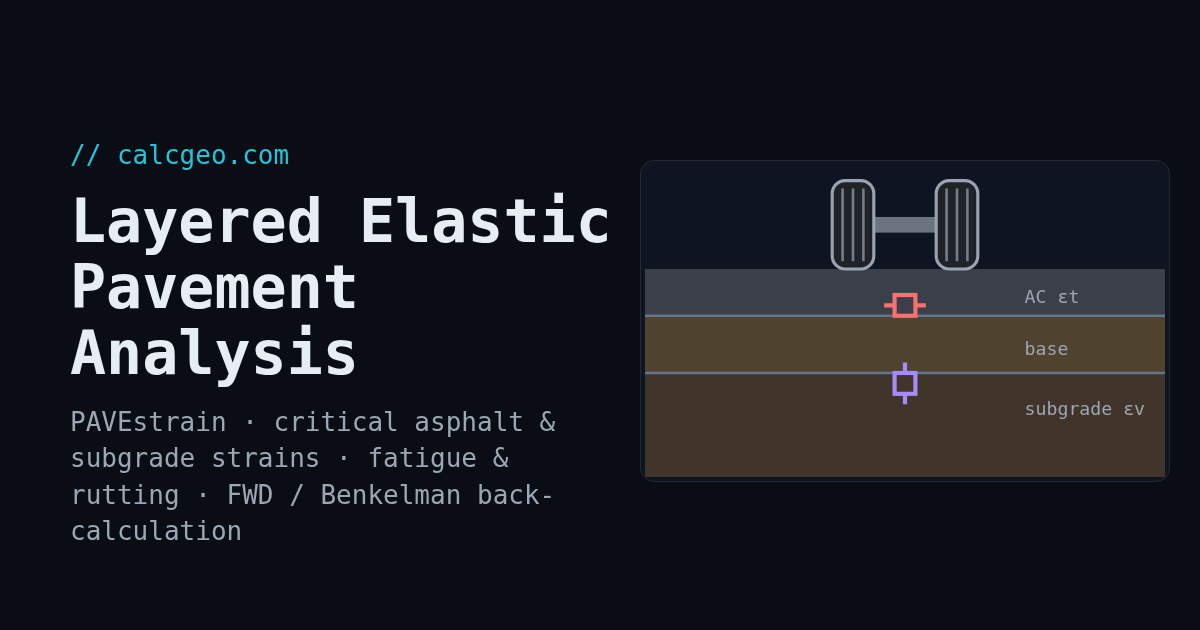
- Automatic critical strains: asphalt tensile strain at the bottom of the asphalt and vertical compressive strain at the top of the subgrade, under single or dual tire loads.
- Fatigue and rutting lives from Asphalt Institute MS-1, Shell and Finn et al. transfer functions, compared side by side, with the controlling model marked.
- Modulus back-calculation from a Falling Weight Deflectometer (FWD) basin or a Benkelman beam rebound deflection, with measured and computed basins plotted.
- Section plot, CSV export and print layout, in US units (lb, in, psi, mils, microstrain).
Browser alternative to desktop LEA tools
Desktop programs such as Everstress, EverStressFE, Kenlayer, ELMOD, CIRCLY and ELSYM5 (an FHWA multilayer elastic analysis program historically popular for pavement analysis) are broader project platforms in the same layered-elastic class. PAVEstrain is a focused US-unit browser applet for critical strains, transfer-function lives, and FWD or Benkelman back-calculation. It is not a drop-in replacement for every desktop feature, nonlinearity, or agency design package.
Critical strains under dual tires
Horizontal tensile strain at the bottom of the asphalt drives bottom-up fatigue; vertical compressive strain at the top of the subgrade drives rutting. Under dual tires the critical location can sit under a tire near the surface and between the tires deeper down, so modelling the actual dual geometry matters.
Fatigue and rutting transfer functions
Asphalt Institute MS-1, Shell, and Finn et al. fatigue models, plus Asphalt Institute and Shell rutting models, are shown side by side with the controlling life marked. They are empirical—use the calibration load (normally the 18-kip single-axle dual).
FWD and Benkelman beam back-calculation
For FWD, enter plate load and radius and the measured basin; selected layer moduli are adjusted within bounds until the computed basin matches. For Benkelman beam, one rebound between the duals can determine one unknown (often the subgrade) or a single scale factor on all layers.
Start using it
Start 3-day free trial, then $9/mo (auto-renews)
Automatic renewal: Card required. Your subscription renews automatically every month until you cancel. When the 3-day free trial ends, your card is charged $9/month, and again every month, unless you cancel before the trial ends. Price may change with advance notice. Cancel anytime online: sign in, click Account, then “Manage or cancel subscription.” Subscription terms.
Start 3-day free trial, then $89/yr (auto-renews)
Automatic renewal: Card required. Your subscription renews automatically every year until you cancel. When the 3-day free trial ends, your card is charged $89/year, and again every year, unless you cancel before the trial ends. Price may change with advance notice. Cancel anytime online: sign in, click Account, then “Manage or cancel subscription.” Subscription terms.
Frequently asked questions
What is layered elastic pavement analysis?
It treats a flexible pavement as a stack of horizontal layers, such as asphalt, base, subbase and subgrade, each with its own thickness, stiffness (elastic modulus) and Poisson's ratio, resting on a layer of unlimited depth. Wheel loads are applied as uniform pressure on circular areas, and the theory gives the deflections, stresses and strains anywhere in the structure. This multilayer linear elastic approach is the mechanistic part of mechanistic-empirical pavement design.
Which strains control asphalt fatigue cracking and subgrade rutting?
Horizontal tensile strain at the bottom of the asphalt drives bottom-up fatigue cracking; vertical compressive strain at the top of the subgrade drives rutting. Under dual tires the worst location can sit under a tire near the surface and between the tires deeper down—so the actual dual geometry matters. PAVEstrain searches for the largest value of each under the loads you enter.
Why does a dual tire load matter?
With dual tires the stresses from the two wheels overlap. Near the surface the worst strain is often under one tire, while deeper in the pavement the worst strain is often between the tires. Analysing the actual tire spacing, rather than a single equivalent wheel, finds the right critical location. PAVEstrain accepts up to 12 circular loads, each with its own position, load and contact pressure or radius, so duals, tandems and other wheel groups can be modelled.
Which fatigue and rutting transfer functions are included?
For fatigue cracking: the Asphalt Institute MS-1 (1982) model, which accounts for the asphalt volumetrics, Shell (1978), and Finn et al. (1977). For subgrade rutting: the Asphalt Institute MS-1 (1982) model and Shell (1985) at 50, 85 and 95 percent reliability. The models are shown side by side with the allowable number of load repetitions from each and which one controls. They are empirical, so use the design load they were calibrated with, normally the 18-kip single-axle dual.
Can I back-calculate layer moduli from FWD or Benkelman beam data?
Yes. For FWD, enter plate load and radius and the measured basin; PAVEstrain adjusts selected layer moduli within bounds until the computed basin matches. For Benkelman beam, one rebound between the duals can determine one unknown (often the subgrade) or a single scale factor on all layers.
Is this an Everstress alternative?
PAVEstrain is a browser multilayer linear elastic pavement analyzer in US units: critical asphalt tensile and subgrade compressive strains under dual tire loads, Asphalt Institute / Shell / Finn transfer-function lives, and modulus back-calculation from FWD basins or Benkelman beam rebound. Desktop programs such as Everstress, EverStressFE, Kenlayer, ELMOD, CIRCLY, or ELSYM5 remain broader project platforms. Use PAVEstrain for focused LEA checks and test-data fits; it is not a full replacement for every desktop feature.
How many layers, loads and points can I enter?
Up to 10 layers (the last one extends to unlimited depth), 12 circular wheel loads and 60 evaluation points. Layer interfaces can be fully bonded, frictionless or partially bonded.
What units does it use?
US customary units: loads in pounds, dimensions in inches, moduli and stresses in psi, deflections in mils and strains in microstrain.
Is this a replacement for a full pavement design?
No. It is a pavement design calculator for the mechanistic analysis step and for checking designs and test data. Results are for engineering guidance and must be reviewed by a qualified engineer against project-specific data, agency requirements and the original references.
Related: PAVEstrain user guide (free) · Layered elastic pavement analysis (All-Access article) · All CalcGeo tools · Learn · Subscription terms