// apps/zedstress
ZEDstress // Δσz
Increase in vertical stress Δσz in an elastic half-space beneath point loads and uniformly loaded rectangles, by Boussinesq and Westergaard. Up to 16 point loads, 16 rectangular loads and 30 stress points. Point loads in pounds (lb), dimensions in feet (ft), pressures and results in psf.
i What ZEDstress does
ZEDstress is a free vertical stress calculator for geotechnical engineers. Enter point loads and uniformly loaded rectangles, pick the points where you want stress, and it returns the increase in vertical stress Δσz at each point, with both methods side by side and a breakdown by load.
- Methods: Boussinesq (1885) isotropic half-space, and Westergaard (1938) laterally restrained (layered) half-space with ν = 0. Rectangles use the corner solutions of Newmark (1935) and Fadum (1948), with signed superposition for points inside, on the edge of, or outside a loaded area.
- Limits: up to 16 point loads, 16 rectangular loads and 30 stress points per run. Loads and points can be at any depth.
- Units: loads in lb, dimensions in ft, pressures and results in psf. An optional lateral coefficient K gives K·Δσz for surcharge-on-wall estimates.
- Output: results table, plan view, per-load contributions, CSV export and a print layout.
- Free: sign in with your email (magic link, no password or card). Calculations run on CalcGeo's servers.
Looking for ZSTRESS? ZEDstress uses the same basis as ZSTRESS, the vertical stress program from Virginia Tech (J. Michael Duncan): Boussinesq and Westergaard solutions for point loads and uniform rectangular loads. ZEDstress is an independent implementation and is not affiliated with Virginia Tech.
New to these methods? Read Vertical stress beneath loads: Boussinesq vs. Westergaard, with equations and worked examples.
00 Settings
🔒 Sign in free to run ZEDstress
ZEDstress is free. It runs on CalcGeo's secure servers, so we just need your email. We'll send a one-time sign-in link (no password, no card).
01 Point loads
Location (x, y) in plan and depth z* of the load; Q in lb.
| # | x (ft) | y (ft) | z* (ft) | Q (lb) |
|---|
02 Rectangular loads
(x, y) = corner with the smallest x and y; B along +x, L along +y; z* = depth of loaded area; q in psf.
| # | x (ft) | y (ft) | z* (ft) | B (ft) | L (ft) | q (psf) |
|---|
03 Stress points
*z is depth, positive downward — not an elevation.
| # | x (ft) | y (ft) | z* (ft) |
|---|
04 Plan view
x → right, y ↑ up. Depths not shown.
05 Results — Δσz (psf)
Press Calculate.
Vertical stress vs depth
Horizontal stress (K·Δσz) vs depth
Per-load breakdown
? FAQ
Is ZEDstress the same as Virginia Tech ZSTRESS?
No. ZEDstress is an independent implementation that follows the same method as ZSTRESS (Zstress), the vertical stress program from Virginia Tech by B. Yan and J. Michael Duncan: Boussinesq and Westergaard solutions for point loads and uniform rectangular loads, combined by superposition. It is not affiliated with, endorsed by, or an official version of Virginia Tech's software.
Is ZEDstress free?
Yes. ZEDstress is free. Sign in with your email (a one-time magic link, no password or card) and run as many calculations as you need, within fair-use rate limits.
What units does ZEDstress use?
US customary units: point loads in pounds (lb), dimensions and depths in feet (ft), and pressures and stress results in pounds per square foot (psf).
06 Basis of design
ZEDstress computes the increase in vertical stress in a homogeneous, linear-elastic, semi-infinite mass (half-space). It follows the same basis as Virginia Tech's ZSTRESS 2.0 (Yan & Duncan, CGPR #27); ZEDstress is an independent implementation and is not affiliated with Virginia Tech. Results from separate loads are superposed.
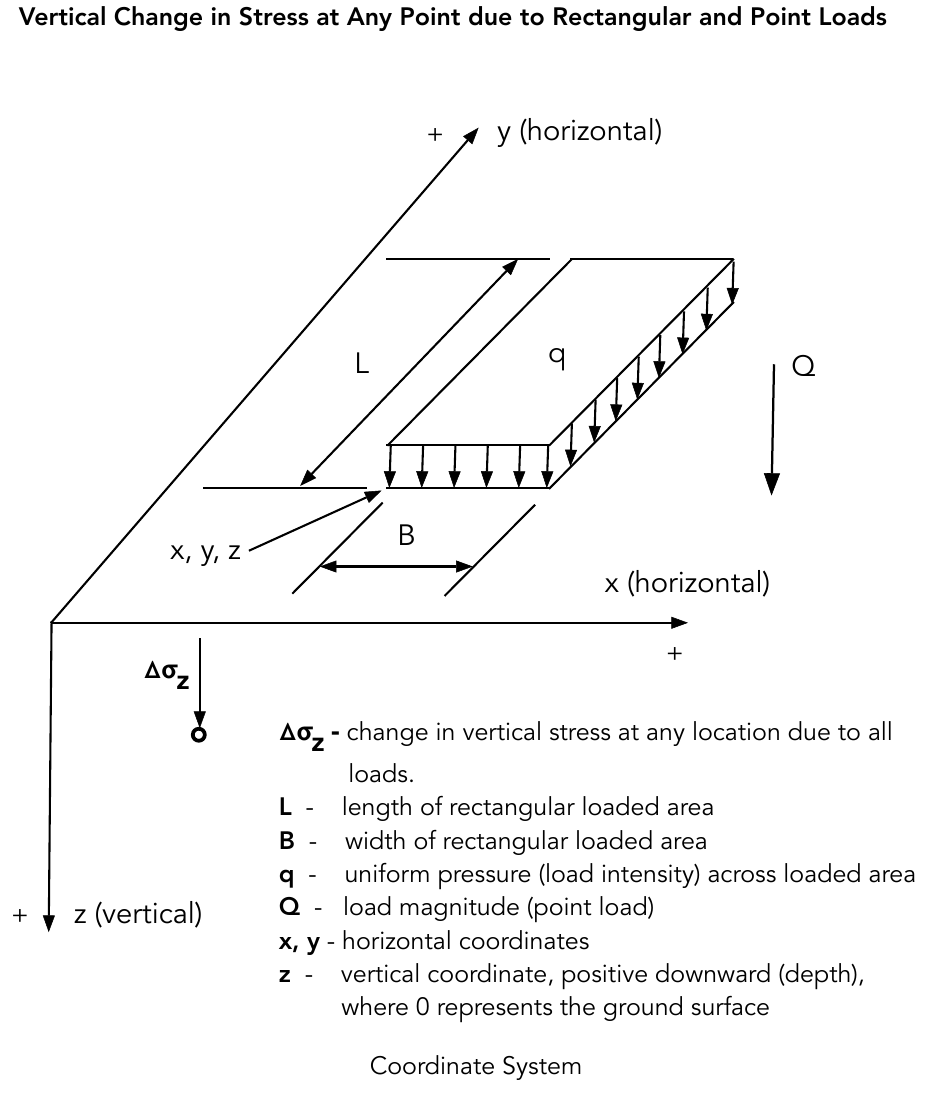
Boussinesq (1885) — isotropic half-space. Point load:
Δσz = 3Q·z³ / (2π·R⁵), R = √(r² + z²)
Westergaard (1938) — elastic mass reinforced by thin rigid horizontal layers (no lateral strain). ZEDstress uses ν = 0 (η² = (1−2ν)/(2−2ν) = ½), per Fadum (1948) and ZSTRESS. Boussinesq vertical stress does not depend on ν.
Δσz = Q/(2√2·π) · z / (r² + ½z²)^1.5
Uniformly loaded rectangle — corner solutions after Newmark (1935) for Boussinesq and Fadum (1948) for Westergaard, with m, n the rectangle sides measured from the point:
Boussinesq:  Δσz = q/(2π) · [ atan(mn / (z·R₃)) + (mn·z/R₃)·(1/(m²+z²) + 1/(n²+z²)) ],  R₃ = √(m²+n²+z²)
Westergaard: Δσz = q/(2π) · atan( √2·mn / (z·√(m² + n² + ½z²)) )
This arctangent form stays on the correct branch for all m, n, so no +π correction is required (the equivalent Newmark form needs +π when m²n² > m²+n²+1; both give identical results). Stress at a point not beneath a corner is the signed sum of four corner rectangles drawn from the point's plan projection, which also handles points outside the loaded area.
Depth conventions. z is depth, positive downward; Δz = zpoint − zload. Below a load (Δz > 0) the results are identical to the ZEDstress 1.0 spreadsheet. The following are intentional departures from the spreadsheet:
- Points above a load (Δz < 0) receive 0 from both rectangles and point loads. (The spreadsheet used |Δz| for point loads, giving a mirror-image stress above a buried point load.)
- Points at a rectangle's depth (Δz = 0) receive the surface value: q strictly inside, q/2 on an edge, q/4 at a corner, 0 outside. (The spreadsheet returned 0.)
- Points at a point load's depth (Δz = 0) receive 0 when offset horizontally. A point exactly on a point load is singular: it is excluded from the total and flagged ⚠ (same as the spreadsheet).
Horizontal stress shown is simply K × Δσz, for surcharge-on-wall estimates.
For the full derivation, assumptions and hand-check examples, see Vertical stress beneath loads: Boussinesq vs. Westergaard.
References: Boussinesq, J. (1885) Application des potentiels…, Gauthier-Villars, Paris · Westergaard, H.M. (1938) “A problem of elasticity suggested by a problem in soil mechanics: soft material reinforced by numerous strong horizontal sheets,” in Contributions to the Mechanics of Solids (Timoshenko 60th Anniv. Vol.), Macmillan · Newmark, N.M. (1935) “Simplified computation of vertical pressures in elastic foundations,” Univ. of Illinois Eng. Exp. Station Circular 24 · Fadum, R.E. (1948) “Influence values for estimating stresses in elastic foundations,” Proc. 2nd ICSMFE, Rotterdam, Vol. 3 · Yan, B. & Duncan, J.M., ZSTRESS 2.0, Virginia Tech Center for Geotechnical Practice and Research.
Results are engineering guidance only, based on idealized elastic theory. Actual stresses depend on layering, stiffness contrasts, footing rigidity and other site conditions. Verify against project-specific analysis and the judgment of a licensed engineer.