// seismic · free
ASCE 7-22 Seismic Design Parameters & Site Class Calculator Free
A free ASCE 7-22 seismic calculator that also helps you choose the correct site class. Enter a measured or estimated shear wave velocity profile, or use the default site class, and the app checks it against ASCE 7-22 Chapter 20: Vs30, how deep the Vs data go, rock limits, and Site Class F. It then gets SDS, SD1, and the multi-period seismic design spectrum from the USGS service and drafts the write-up for your geotechnical report.
Free Free with a CalcGeo account. Sign in with your email to open the app. No card and no trial clock.
What it does
- USGS ASCE 7-22 lookup by latitude and longitude: SMS, SM1, SDS, SD1, PGAM, and the seismic design category for your risk category.
- Vs30 calculator and site class: enter Vs30 directly or a layered shear wave velocity profile by top and bottom depth, in ft/s or m/s.
- New ASCE 7-22 site classes BC, CD, and DE, plus the default site class when you have no Vs data, and an optional override.
- Site class guidance built in: warnings for Vs data shallower than 100 ft or 50 ft, estimated Vs that lands in rock Class A or B, the soft clay rule, and Site Class F screening (see below).
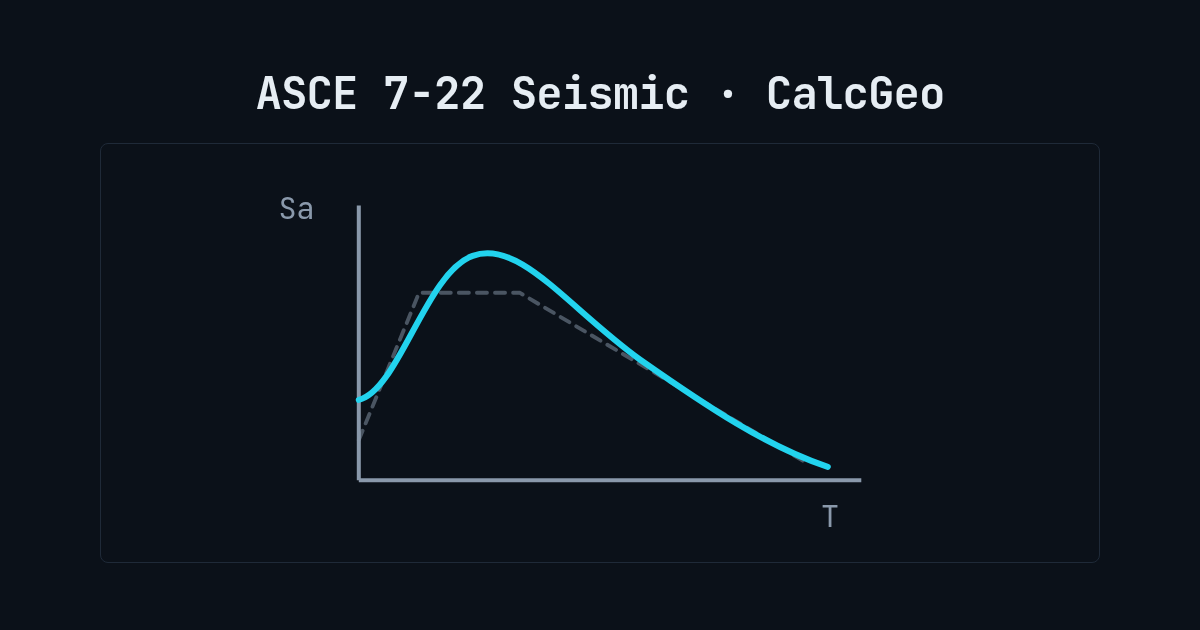
- Multi-period and two-period spectra plotted together, with copyable x,y period–acceleration pairs for spreadsheets and structural software.
- Report-ready "Seismic Site Coefficients" write-up you can paste into a geotechnical report.
Guidance on choosing the correct site class
The class you pick sets SDS and SD1, so the app applies the ASCE 7-22 Chapter 20 rules as you enter data, and the Draft Report states which rule was used:
- Vs30 from measured or estimated shear wave velocity. v̄s is the travel-time average over the top 100 ft (Equation 20.4-1). For Vs estimated from correlations, the app checks v̄s, v̄s/1.3, and 1.3v̄s and keeps the most critical class (Section 20.3).
- No N-bar or su-bar tables. ASCE 7-22 classifies sites by v̄s only. SPT blow counts, CPT tip resistance, and shear strength are used through shear wave velocity correlations (Sections 20.1 and 20.3), so the app takes an estimated Vs profile rather than N̄ or s̄u.
- How deep the Vs data must go. v̄s covers 100 ft. From 50 to 100 ft, the last layer is extended to 100 ft only where the site geology makes soft layers unlikely between 50 and 100 ft. With less than 50 ft of data, Section 20.3 calls for the default site class unless the site geology justifies another class. The app flags shallow profiles, switches to the default, and records any geologic basis you enter.
- Default site class. With no Vs data, use the most critical of Site Classes C, CD, and D, unless the authority having jurisdiction or geotechnical data show DE, E, or F (Sections 11.4.2.1 and 20.1).
- Rock: Site Class A and B. Class B needs shear wave velocity measured on site, and rock estimated from geology alone is Class BC (Section 20.2.4). Class A needs measurements on site or in the same formation (Section 20.2.5). The app flags estimated Vs that falls in A or B.
- Soft clay. More than 10 ft of soft clay (su < 500 psf, w ≥ 40%, PI > 20) is Site Class E regardless of v̄s (Section 20.2.2).
- Site Class F. Screen for liquefiable soils, quick and highly sensitive clays, collapsible weakly cemented soils, peat over 10 ft, very high plasticity clay over 25 ft, and very thick soft/medium stiff clay over 120 ft (Section 20.2.1). Site Class F needs a site response analysis under Section 21.1. The app can't compute one: it shows the non-F class values for reference only, with a warning. The only exception it offers is the one for liquefiable soils with a fundamental period of 0.5 s or less.
Start using it
Free The ASCE 7-22 seismic calculator is free with email sign-in (a free CalcGeo account). No card, no trial clock.
Frequently asked questions
Is the ASCE 7-22 seismic calculator free?
Yes. It's free with a CalcGeo account: sign in with your email to open the app. There is no card and no trial period. Signing in is required, so the app pages and the Learn article aren't public.
How deep does shear wave velocity data need to go for the ASCE 7-22 site class?
v̄s is computed over the top 100 ft (Sections 20.1 and 20.4). If the data reach more than 50 ft but less than 100 ft, Section 20.3 extends the last layer's velocity to 100 ft only where the site geology makes soft layers unlikely between 50 and 100 ft. If the data don't reach 50 ft, the default site classes of Section 20.1 are used unless another site class can be justified on the basis of the site geology. The calculator flags each case and switches to the default site class below 50 ft unless you enter a geologic basis, which goes into the report.
What is Site Class F in ASCE 7-22?
Site Class F applies where the profile includes soils vulnerable to failure or collapse under seismic loading (liquefiable soils, quick and highly sensitive clays, collapsible weakly cemented soils), more than 10 ft of peat or highly organic clay, more than 25 ft of very high plasticity clay (PI > 75), or more than 120 ft of soft/medium stiff clay (su < 1,000 psf) (Section 20.2.1). A site response analysis under Section 21.1 is then required. For liquefiable soils only, structures with a fundamental period of 0.5 s or less may use a site class from Section 20.2 for spectral accelerations. The two clay criteria are exempt in Seismic Design Category A and B. The calculator screens for F and labels any mapped values for an F site as reference only.
Can I use N-bar or su-bar to classify a site under ASCE 7-22?
Not directly. ASCE 7-22 Chapter 20 classifies sites by the average shear wave velocity v̄s. Where Vs is not measured, it is estimated from correlations with SPT blow counts, CPT tip resistance, shear strength, or other parameters (Sections 20.1 and 20.3), and the site class is checked at v̄s, v̄s/1.3, and 1.3v̄s. Enter the estimated Vs profile in the calculator as "estimated".
How is Vs30 calculated from a layered shear wave velocity profile?
Vs30 (written v̄s in ASCE 7-22) is the time-averaged shear wave velocity of the top 100 ft: Vs30 = 100 ft / Σ(di / Vsi), where di is the thickness of layer i and Vsi its shear wave velocity, summed over the top 100 ft. It is a travel-time average, not an arithmetic average, so soft layers pull it down strongly. The calculator does this from your layer top and bottom depths and assigns the shear wave velocity site class.
What are Site Classes BC, CD, and DE in ASCE 7-22?
ASCE 7-22 Table 20.2-1 splits the old classes into nine: A (hard rock, Vs30 > 5,000 ft/s), B (medium hard rock, 3,000–5,000), BC (soft rock, 2,100–3,000), C (very dense sand or hard clay, 1,450–2,100), CD (dense sand or very stiff clay, 1,000–1,450), D (medium dense sand or stiff clay, 700–1,000), DE (loose sand or medium stiff clay, 500–700), E (very loose sand or soft clay, ≤ 500), and F (soils requiring site response analysis). The intermediate classes reduce the jump in design values at old class boundaries.
Why does ASCE 7-22 no longer use Fa and Fv tables?
In ASCE 7-22 the USGS Seismic Design Geodatabase provides MCER multi-period response spectra already computed for each site class, so SMS, SM1, SDS, and SD1 come directly from the USGS seismic design maps service for the site's latitude, longitude, and site class rather than from Fa and Fv coefficient tables. The calculator retrieves these values, including PGAM, along with the multi-period spectrum.
What site class should I use if I have no shear wave velocity data?
Where soil properties are not known in enough detail to determine the site class, ASCE 7-22 Section 20.1 requires the default site class: use the most critical spectral response accelerations at each period of Site Classes C, CD, and D, unless the authority having jurisdiction or geotechnical data determine that Site Class DE, E, or F soils are present. Where Vs is estimated rather than measured, Section 20.3 requires considering a range of Vs (the estimate divided and multiplied by 1.3) and using the more critical result. The calculator offers the default site class when no Vs data are entered.
Can I enter shear wave velocity in m/s?
Yes. CPT and geophysical data often arrive in m/s, so the layered Vs table has an English/SI toggle. Values are converted to ft/s for classification because ASCE 7-22 prints rounded metric boundaries (for example 305 m/s for 1,000 ft/s) that differ slightly from the ft/s limits; classifying in ft/s keeps results consistent with the governing table.
What is the difference between the multi-period and two-period design spectrum?
The multi-period spectrum (ASCE 7-22 Section 11.4.5.1) is the USGS-provided spectrum at 22 periods for the site and site class and is the primary design spectrum. The two-period spectrum (Section 11.4.5.2) is the traditional shape built from SDS, SD1, and TL, used where the multi-period spectrum is not available. The calculator plots both and lets you copy the x,y pairs.
Where do the USGS values come from, and what if a design program's USGS lookup fails?
The values come from the USGS Seismic Design Geodatabase (DOI 10.5066/P9I0R4O6), queried through the USGS ASCE 7-22 web service at earthquake.usgs.gov/ws/building-codes/asce7-22. The calculator calls that same service. If a design program returns zeros or will not refresh, check that it uses the current /ws/building-codes/ path, then pull the values from the service, the ASCE Hazard Tool, or this calculator and enter them by hand. See the USGS Seismic Design Geodatabase guide.
How is the Seismic Design Category determined?
If mapped S1 is 0.75 g or more, the category is E for Risk Category I, II, or III and F for Risk Category IV. Otherwise it is the more severe result of ASCE 7-22 Table 11.6-1 (SDS) and Table 11.6-2 (SD1) for the Risk Category. The calculator reports the category returned by the USGS service; it does not apply the Section 11.6 short-period exception or the Section 12.14 simplified procedure, which need structural information. See the ASCE 7-22 Seismic Design Category guide.
Does this apply to my building code?
The calculator follows ASCE 7-22 only. Where the governing building code adopts ASCE 7-22 for seismic loads, the site class, SDS, SD1, and seismic design category follow it as shown here. Check the governing local building code, its adopted edition, and any amendments.
Is the calculator a substitute for engineering judgment?
No. Results are for engineering guidance and must be checked by a qualified, licensed engineer against project-specific data, the governing code, and site conditions. Site-specific ground motion procedures (Chapter 21) are required in some cases, such as Site Class F. CalcGeo makes no warranty of accuracy for any particular use.
Related: ASCE 7-22 site class & Vs30 guide (public) · USGS Seismic Design Geodatabase guide (public) · ASCE 7-22 Seismic Design Category guide (public) · ASCE 7-22 seismic design parameters (Learn article, free with sign-in) · All tools · Subscription terms